
Choosing an elevator for areas with high traffic loads (e.g., shopping centers, public buildings, schools, hospitals, office buildings) is no simple task. The factors that must be considered go beyond basic characteristics (speed – payload) and involve durability, drive technology, duty cycles, and the optimization of passenger flow.
Technical Design Parameters
The key technical variables that must be defined during the study phase include:
-
- Nominal load (Q) and cabin capacity
Depending on the use, elevators ranging from 630kg (8 persons) to 1600kg+ are required for public buildings.
For commercial uses or public service buildings, larger cabins with easy access for people with disabilities are recommended (compliance with EN 81-70). - Lifting speed (V)
Usually between 1.0–1.6 m/s, depending on building height and the number of stops.
In buildings with more than 5 floors or high traffic pressure, increasing the speed is recommended to decongest flows. - Duty cycle
Selection of machines with high resistance to continuous starts/stops (starts/hour).
Ideally, the use of gearless machines for smooth and quiet operation with reduced maintenance. - Drive type
Electric MRL (Machine Room Less) elevators: ideal for buildings with increased flow requirements and space-saving needs.
Hydraulic elevators: less suitable for heavy traffic due to lower speeds and duty cycles, unless selected with reinforced systems. - Call management system
Installation of priority distribution software and group control in buildings with multiple elevators.
Capability for pre-programmed destinations and peak-hour service (e.g., afternoon employee exit).
- Nominal load (Q) and cabin capacity
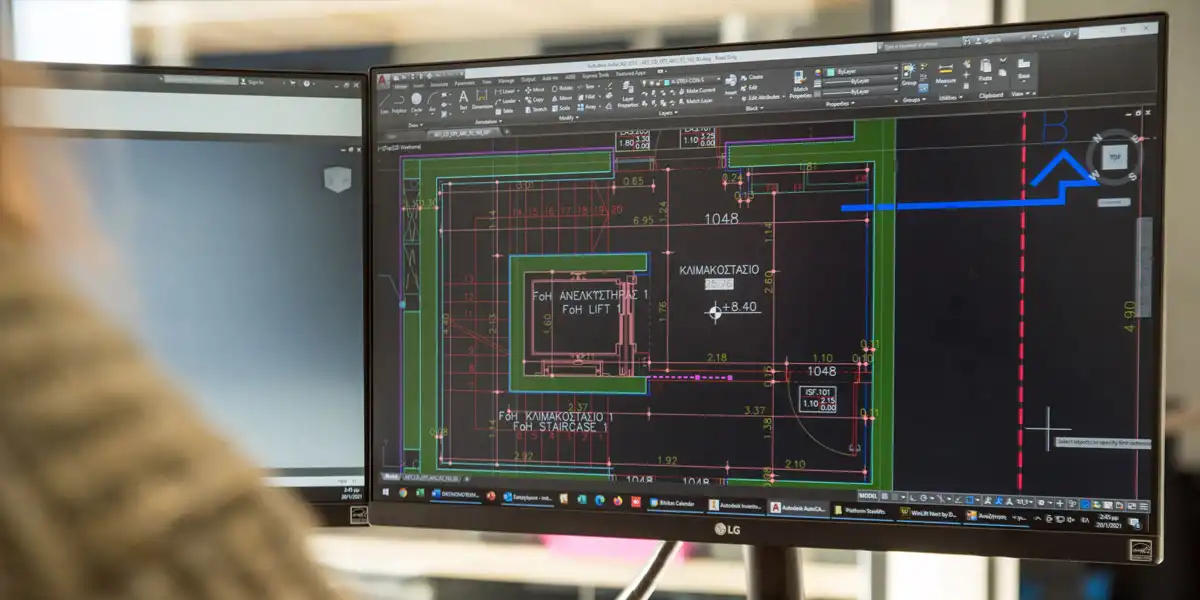
Construction Provisions – Shaft and Formwork
In new construction projects, the dimensioning and elevator shaft formwork must align with the elevator specifications and the concrete reinforcement. Deviations in the load-bearing structure of the shaft cause installation problems and project delays. For this reason, it is critical that static and architectural studies are drafted in collaboration with the elevator manufacturer from the foundation stage.
Durability and Aesthetics
For use in high-wear environments, emphasis should be placed on:
- Cabin finishes made of stainless steel, compact laminate, or anti-graffiti materials.
- PVC or stone-resin flooring for durability under heavy use.
- Control panels with vandal-proof features and illuminated indicators.
- Automatic doors with reinforced mechanisms, operating with safety photocells.
Certifications & Compliance
All elevators for public or commercial buildings must comply with:
- EN 81-20 / EN 81-50 (technical compliance & testing)
- EN 81-70 (accessibility)
- EN 81-72 (in cases of fire protection / fire safety)
- Full CE file, weight testing, and documentation for public works supervision
Recommendations for Engineers & Architects
During the design or study phase, it is recommended to:
- Collaborate with the elevator manufacturer from the architectural planning stage.
- Dimension the shaft and machine room (or select MRL) based on technical data sheets.
- Take into account daily passenger flow and peak hours.
- Define energy consumption (Class A-B) and use inverters for optimization.
The Technical Approach of Bibikas Elevators
The Bibikas team works closely with civil engineers and technical offices for:
- Traffic requirement analysis and proposal of the appropriate elevator type
- Provision of a full technical file for public and private projects
- Technical support and installation supervision
- After-sales maintenance with full spare parts compatibility and rapid response times
Choosing the right elevator for high-traffic areas is not a simple product decision—it is a technical decision with significant implications for the building’s operation. Collaborating from the start of the project with specialized professionals in the field ensures correct operation, durability, and compliance.
For more information contact Bibikas Elevators.
Call us at 2221094777 and one of our specialized associates will support you with every need.